Five heart medicines in Australia: what each one is for
Metoprolol, losartan, clopidogrel, apixaban and rivaroxaban do different jobs. Understand an Australian medicine list, monitoring and questions to ask.
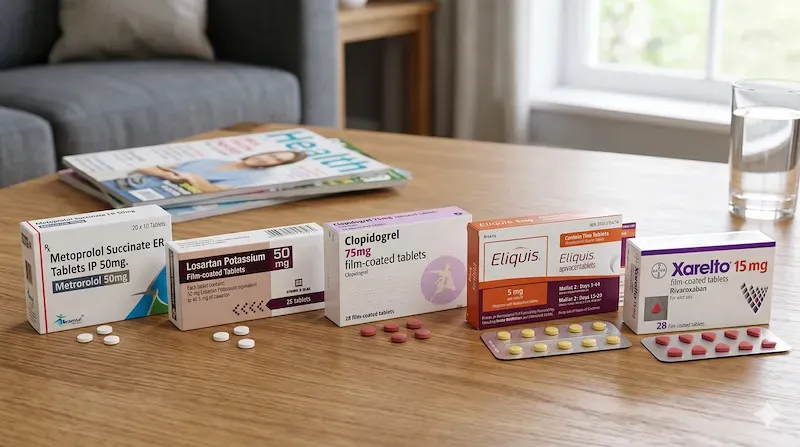
A row of boxes on the kitchen bench, a pile of instructions, and one very reasonable question: why does one heart need all these medicines?
Metoprolol, losartan, clopidogrel, apixaban and rivaroxaban often turn up on heart prescriptions, but heart rate, blood pressure, sticky platelets and blood clots are four different jobs. The best first step is to write the reason next to each name on your own list.
The details here come from Australian product information. Your brand’s official leaflet (the CMI) and your prescription carry your own instructions; to find the leaflet, start with the Australian medicine finder.
Heart rate, blood pressure, platelets and clotting
| Medicine | Main job | Worth asking at your review |
|---|---|---|
| Metoprolol | Slows the heart and dampens its response to adrenaline; uses depend on the form | Which form am I on, and what pulse or symptoms should I report? |
| Losartan | Lowers blood pressure; also used for some diabetic kidney disease | When are my kidney and potassium tests due? |
| Clopidogrel | Makes platelets less sticky, for example after some heart attacks, strokes or stents | Why am I on it, and should I be taking aspirin as well? |
| Apixaban | Prevents clots in atrial fibrillation, after some clots and after certain operations | Is my dose right for why I’m taking it and for my health now? |
| Rivaroxaban | Prevents clots, with different schedules for different uses | Which stage of treatment am I in, and do I take it with food? |
These are different roles, not five alternatives to pick from, and certainly not a suggestion to take all five. The Australian product leaflets list what each product is approved for and its precautions.
Metoprolol: check which kind you have
Metoprolol blocks beta receptors, which can slow your pulse and ease the load on your heart. Same ingredient, two salts. Australian Betaloc is metoprolol tartrate; Topreloc-XL is metoprolol succinate, built to release slowly over the day. So a box swap can quietly change the timing too. Ask the pharmacist rather than working it out at home. Wheezy, or living with asthma or COPD? Your doctor needs to know. And never stop metoprolol overnight. Betaloc information, Topreloc-XL information
Losartan: the kidney and potassium checks
Losartan blocks a hormone called angiotensin II, which lets your blood vessels relax. In people with type 2 diabetes and protein in their urine, it can also slow kidney damage. You’ll still need regular kidney and potassium checks. And a potassium-based salt substitute or supplement is worth running past the pharmacist, even if it’s sold as the healthy option. Cozaar information
Clopidogrel, apixaban and rivaroxaban aren’t the same thing
Clopidogrel makes platelets less likely to clump together. After a stent it has a different job from a blood thinner used for atrial fibrillation. Stopping it without a plan can be dangerous. Plavix information
Apixaban and rivaroxaban block factor Xa, one of the proteins your blood uses to build a clot. They don’t dissolve a clot you already have; they stop it growing while your body clears it. If you’re on more than one clot-preventing medicine, ask how long the combination should last and who will review it.
What the apixaban versus rivaroxaban study actually looked at
A US study followed 581,451 Medicare patients aged 65 or over who started one of the two for atrial fibrillation. Those on rivaroxaban had more major clotting events and serious bleeds than those on apixaban. But it was an observational study, not a randomized trial, so differences between the two groups of patients may explain some of the gap. It doesn’t prove why the difference happened, or that one drug is best for every use. Original JAMA study
No INR tests, but still checks
On apixaban or rivaroxaban you’ll still be checked for anemia, kidney and liver problems, interactions, and whether your dose or reason for treatment has changed. Regular INR tests are for warfarin; they don’t work for adjusting apixaban or rivaroxaban. Carry an up-to-date medicine list, and tell your doctors and dentist you’re on a blood thinner.
No INR appointments doesn’t mean no follow-up. Ask which blood tests are due and who looks at the results. Keep the reason, the dose and the date of your last review together on your list, especially if you see more than one clinic.
Food, missed doses and your exact prescription
Rivaroxaban 15 mg and 20 mg tablets need to be taken with food. Apixaban is twice a day. Rivaroxaban is once a day for some adult uses, but the first three weeks of treating a DVT or PE are twice a day. Write down which stage you’re in, not just the medicine name. Australian Xarelto information
So “one heart tablet a day” doesn’t work as an instruction for every box.
What if I miss a dose?
It depends on your product and your schedule. The Eliquis consumer leaflet says to take a missed dose when you remember, unless your next one is nearly due. The NSW DOAC guideline gives a six-hour window for twice-daily apixaban or dabigatran. Those two sources say slightly different things, so get a clear plan for you from your pharmacist. Rivaroxaban’s twice-daily starting phase has its own rules. One rule for all five medicines would be unsafe.
Why the reason and the kidney check come first
For atrial fibrillation not caused by a valve problem, the Australian Eliquis PI lowers the apixaban dose to 2.5 mg twice a day when at least two of these apply:
- age 80 or older;
- weight 60 kg or less;
- serum creatinine 133 micromol/L or higher.
Exactly 60 kg and exactly 133 micromol/L count. That rule only applies to atrial fibrillation; it’s not a dose calculator for every use of apixaban. Treating a DVT or PE and preventing clots after surgery have their own schedules. The Australian PI also rules it out when creatinine clearance is below 25 mL/min; don’t borrow rules from another country’s label. Australian Eliquis PI
The NSW guideline uses a calculated creatinine clearance for these decisions, which isn’t the same as the eGFR on most blood-test reports. Leave that sum to your team. Ask for a fresh review after a bad illness, dehydration, a change in kidney function or a new medicine that interacts. NSW DOAC guideline
It’s also wrong to say every use of these medicines in under-18s is off-label. In 2022 the TGA registered rivaroxaban oral suspension for blood clots in children, for those who’ve already had some anticoagulant treatment. That doesn’t cover every DOAC or every tablet strength. Other off-label use needs a specific clinical decision; a use you read about online isn’t automatically approved. TGA registration
Check interactions before you buy anything new
Before you pick up ibuprofen, naproxen, aspirin, a supplement or a herbal remedy, ask the pharmacist to check your whole list. Several of these raise the risk of bleeding. If aspirin is prescribed, that may be deliberate, so don’t drop it just because the combination carries more risk.
Omeprazole and esomeprazole can stop clopidogrel working as well. Nexium is esomeprazole, not omeprazole. You may still need stomach protection, so the answer is a review of your exact product by your doctor or pharmacist. Not every stomach medicine is the same, and don’t switch on your own. MHRA interaction advice
On losartan, ask about potassium supplements and salt substitutes. On metoprolol, mention feeling faint, a very slow pulse or new breathing trouble. Alcohol can make dizziness and bleeding worse; a chat about your own drinking beats a one-size-fits-all limit.
Dental work and procedures: who makes the plan?
Tell the team well ahead. Some small procedures go ahead without stopping anything; others need a careful stop-and-restart plan. It depends on the procedure, your clot risk, the medicine, your kidneys and when you took the last dose. Don’t stop treatment, or use a waiting time for spinal procedures, based on something you read.
Bleeding: when to get help
Some bruising is normal on these medicines. Mention new or ongoing bleeding. Get urgent help for bleeding that won’t stop, vomiting blood, black stools, collapsing, a sudden severe headache or signs of a stroke. Tell them which medicine you take and when you last took it.
Can a blood thinner be reversed in an emergency?
Hospitals have plans for serious bleeding, but don’t assume a particular antidote is on the shelf. The TGA says Andexxa’s provisional Australian registration lapsed on 20 May 2026, and it was removed from the ARTG. Older approval news doesn’t tell you what’s available now or what a given hospital uses. TGA update
Costs and brands in Australia
Eliquis isn’t the only apixaban in Australia; Apexa is another. Being registered doesn’t mean your pharmacy has it. Check the ingredient, strength, release form and whether swapping is OK for you. Apexa information
For eligible PBS prescriptions in 2026, the most you pay per script is A$25 for general patients and A$7.70 with a concession card. Eligibility, the safety net and brand premiums can change your bill, so these aren’t fixed prices for every box. PBS co-payments
For where cholesterol medicines fit in heart prevention, see choosing a statin and cholesterol medicines in Singapore.
What should I bring to a medicine review?
Bring the boxes, a full list including anything you buy without a prescription, recent test results if you have them, and a note of symptoms or missed doses. Then ask: what is each one preventing, what needs checking, and who do I call if something goes wrong?
Keep one list, with the reason for each medicine and how you actually take it. A photo of each box helps when brands change or another clinic needs the details. If a cholesterol medicine is on there too, the follow-up test guide explains what its blood tests are for.
Sources
13 sources
Checked in October 2026.
- Betaloc — Australian PI/CMI records
- Topreloc-XL — Australian PI/CMI records
- Cozaar — Australian PI/CMI records
- Plavix — Australian PI/CMI records
- Eliquis — Australian PI/CMI records
- Xarelto — Australian PI/CMI records
- Apexa — Australian PI/CMI records
- DOAC Guidelines, version 1.1 — NSW Clinical Excellence Commission
- Apixaban/rivaroxaban Medicare cohort — Ray and colleagues, JAMA 2021
- Pediatric rivaroxaban registration — TGA
- Andexxa registration lapse — TGA
- PBS patient contributions
- MHRA clopidogrel/PPI advice