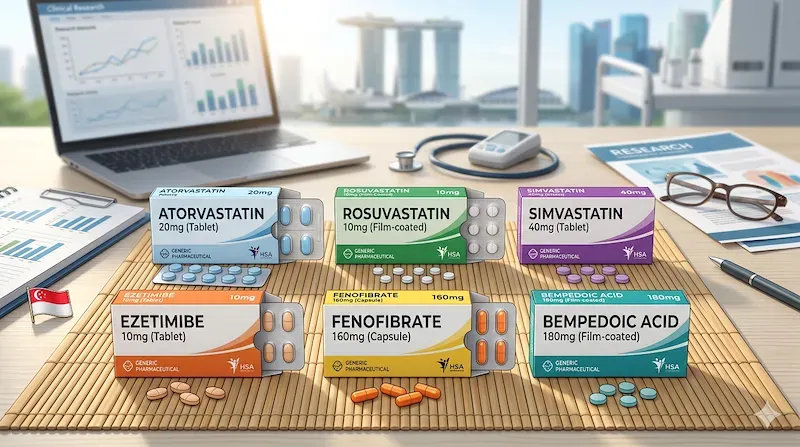
A Comparative Analysis of Pharmacological Strategies in Cholesterol Management: Clinical Realities and Patient Pathways in Singapore

This report synthesizes educational information from medical archives, clinical guidelines, and patient platforms. It supplements professional medical advice. Consult a registered medical professional in Singapore before starting or modifying a medication regimen. The Health Sciences Authority (HSA) and Ministry of Health (MOH) Singapore update brand names, regulatory statuses, and pricing structures regularly.

The Landscape of Hyperlipidemia in the Singaporean Population

Preventive medicine in Singapore prioritizes cholesterol management as the population ages and lifestyle habits change. Hyperlipidemia (elevated blood lipids) increases the risk of atherosclerotic cardiovascular disease, including heart attacks and strokes [1]. Ministry of Health (MOH) Singapore recorded an increase in hyperlipidemia prevalence among adults aged 18 to 69, rising from 35.5% in 2017 to 39.1% in 2021-2022 [1]. Patients and clinicians must understand available pharmaceutical interventions to mitigate long-term health risks.

Lipid-lowering therapy aims to reduce low-density lipoprotein cholesterol (LDL-C), or “bad cholesterol” [2]. Excess LDL-C forms fatty deposits on blood vessel walls.

Over time, these deposits block blood flow or rupture, causing myocardial infarctions or ischemic strokes [1]. Clinicians in Singapore evaluate patients using the Singapore-FRS-2023 risk assessment tool. This tool calculates a 10-year cardiovascular risk score to determine therapy intensity and specific LDL-C targets [4].

Doctors tailor treatment to the patient. Patients begin with dietary adjustments, smoking cessation, and increased physical activity. When lifestyle changes fail to hit target lipid levels, doctors prescribe medication [4]. Clinicians select specific agents by weighing potency, safety profiles, cost, kidney function, and liver health [5].

Profiles of Targeted Medications and Local Branding

Singapore categorizes cholesterol medications into statins, cholesterol absorption inhibitors, fibrates, and adenosine triphosphate citrate lyase (ACL) inhibitors. Patients and doctors use local brand names and generic counterparts to navigate polyclinics and private specialist centers.

The Statin Class: Atorvastatin, Rosuvastatin, and Simvastatin

Doctors prescribe statins as a first-line therapy. Extensive evidence links them to reduced cardiovascular events [3].

  • Atorvastatin: Pfizer markets this as Lipitor. It offers high potency and flexible dosing [3]. Pharmacies and public health institutions stock generic versions.
  • Rosuvastatin: AstraZeneca brands this as Crestor. It ranks among the most potent statins [3]. Asian populations require careful titration; they experience higher systemic drug exposure compared to Western populations [3].
  • Simvastatin: Merck markets this traditional statin as Zocor [3]. The public health system relies on it for cost-effectiveness. Patients take it at night to align with the body’s cholesterol synthesis cycle. It carries a higher risk of drug interactions [3].

Non-Statin and Adjunctive Therapies: Ezetimibe, Fenofibrate, and Bempedoic Acid

When patients fail to tolerate statins or miss LDL-C targets, doctors prescribe alternative medications.

  • Ezetimibe: MSD brands this cholesterol absorption inhibitor as Ezetrol [10]. Doctors combine it with statins to achieve additional LDL-C reduction [2].
  • Fenofibrate: Abbott markets this drug as Lipanthyl or Trilipix to manage high triglycerides [11]. Specialists also prescribe it to treat microvascular complications of diabetes [13].
  • Bempedoic Acid: Esperion Therapeutics brands this newer therapy as Nilemdo or Nexletol [15]. It remains inactive in skeletal muscle, providing an alternative for patients experiencing statin-associated muscle symptoms [17].

Table 1: The Quick Snapshot of Medications in Singapore

Generic NameCommon Brand (Local)Typical Dose FrequencyGeneric Available
AtorvastatinLipitorOnce DailyYes
RosuvastatinCrestorOnce DailyYes
SimvastatinZocorOnce Daily (Evening)Yes
EzetimibeEzetrolOnce DailyYes
FenofibrateLipanthylOnce DailyYes
Bempedoic AcidNilemdo / NexletolOnce DailyNo (Newer Entry)

Mechanism of Action: Biological Pathways to Lipid Reduction

The liver synthesizes most of the body’s cholesterol. The digestive system acquires the remainder through dietary intake [1].

Statins: HMG-CoA Reductase Inhibition

Atorvastatin, Rosuvastatin, and Simvastatin target the liver. They inhibit the HMG-CoA reductase enzyme, stopping internal cholesterol production [3].

When internal cholesterol levels drop, the liver increases LDL receptors on its surface [17]. These receptors pull LDL-C out of the bloodstream, reducing circulating “bad cholesterol” [3].

Ezetimibe: The Gut-Blood Barrier

Ezetimibe operates in the small intestine. It targets the NPC1L1 protein transporter, blocking the absorption of dietary and biliary cholesterol into the bloodstream [10]. This process reduces the cholesterol delivered to the liver. The liver then increases LDL receptor expression to compensate, complementing statin therapy [18].

Bempedoic Acid: The Upstream Liver-Specific Switch

Bempedoic acid enters the body as a prodrug. The very long-chain acyl-CoA synthetase 1 enzyme, found in the liver, activates it [19]. Active Bempedoic acid inhibits adenosine triphosphate citrate lyase (ACL), an enzyme located upstream of the statin target in the cholesterol synthesis pathway [15]. Skeletal muscle lacks the activating enzyme. Bempedoic acid avoids muscle cell pathways, preventing the muscle pain associated with statins [17].

Fenofibrate: The Triglyceride Clearance Engine

Fenofibrate activates the Peroxisome Proliferator-Activated Receptor Alpha (PPAR-α) [12]. This activation increases lipoprotein lipase production. Lipoprotein lipase breaks down triglycerides in the blood [22]. Fenofibrate also shifts LDL particle composition to prevent blockages and increases high-density lipoprotein (HDL) [3].

Clinical Indications and Off-Label Applications

The Health Sciences Authority (HSA) approves specific indications for these drugs. Doctors in Singapore extend these uses based on clinical research.

Standard Indications

  • Primary Prevention: Doctors prescribe statins to high-risk individuals without a history of heart attacks or strokes [5].
  • Secondary Prevention: Patients with established atherosclerotic cardiovascular disease (ASCVD), such as those with stents or bypass surgeries, require statin therapy [4].
  • Heterozygous Familial Hypercholesterolemia (HeFH): Genetic mutations cause high LDL-C levels from a young age, requiring aggressive treatment [5].

Off-Label and Emerging Uses

Clinical specialists prescribe medications for unlisted benefits supported by expert consensus.

  • Fenofibrate for Diabetic Retinopathy: Singapore Eye Research Institute (SERI) trials show Fenofibrate slows diabetic retinopathy progression [13]. It reduces inflammation and stabilizes retinal nerves, preventing blindness in type 2 diabetic patients [14].
  • Bempedoic Acid for Statin Intolerance: Doctors prescribe Bempedoic acid for patients who experience muscle symptoms across multiple statin trials, providing an alternative route to hit LDL-C targets [2].

Efficacy Comparison: Potency and Speed of Action

The Ministry of Health Agency for Care Effectiveness (ACE) categorizes statins by LDL-C reduction potential [4].

  • High-Intensity Statins: Rosuvastatin (20–40 mg) and Atorvastatin (40–80 mg) reduce LDL-C by 50% or more [7]. Rosuvastatin achieves greater reductions at lower doses than Atorvastatin [7].
  • Moderate-Intensity Statins: Atorvastatin (10–20 mg) and Simvastatin (20–40 mg) yield a 30% to 49% reduction [7].
  • Ezetimibe Efficacy: Monotherapy provides a 15% to 22% reduction. Adding Ezetimibe to a statin drops LDL-C by an additional 18% to 25% [3].
  • Bempedoic Acid Potency: Bempedoic acid achieves a 15% to 25% reduction [15]. Combining it with Ezetimibe reduces LDL-C by 36% to 38% [17].

Speed of Response

Statins and non-statin oral therapies show effects within two weeks. Full lipid-lowering results appear after four to six weeks [3]. Clinicians check lipid panels six to twelve weeks after initiating or adjusting medication [3].

Table 2: Efficacy and Safety Overview

Medication NameKey BenefitMost Common Side Effect
AtorvastatinReliable, large evidence base, flexible dosingMild muscle aches
RosuvastatinPotent at lower doses; effective for FHHeadache, nausea, or muscle pain
SimvastatinCost-effective; well-studied over decadesMuscle symptoms; interaction risk
EzetimibeExcellent safety; potent as an add-onMild gastrointestinal upset
FenofibrateSuperior for triglycerides and eye protectionNausea or stomach pain
Bempedoic AcidUseful for statin-intolerant patientsIncreased uric acid, Gout

Side Effects, Safety, and Monitoring Protocols

Patients monitor side effects when starting long-term cholesterol therapy.

Common Adverse Reactions

  • Gastrointestinal Distress: Patients report nausea, abdominal pain, and constipation across all classes [1].
  • Muscle Symptoms: Statin-associated muscle symptoms (SAMS) range from mild soreness to localized weakness [1].
  • Metabolic Changes: Statins cause mild increases in blood glucose levels in patients at risk for diabetes [2].

Serious Risks

  • Rhabdomyolysis: Skeletal muscle tissue breaks down rapidly [26]. Patients experience intense muscle pain, weakness, and dark urine [12]. High-dose statins combined with gemfibrozil increase this risk [3].
  • Hepatotoxicity: Medications cause rare liver injury. Clinicians check serum transaminases (ALT and AST) before starting therapy. Patients report jaundice or dark urine [5].
  • Hyperuricemia and Gout: Bempedoic acid increases blood uric acid levels, triggering gout in susceptible patients [15].

Monitoring Requirements in Singapore

Primary Care Pages outline monitoring schedules [5].

  • Lipid Profile: Clinicians test stable patients annually. They test patients 6–12 weeks after dose changes [3].
  • Liver Function (ALT/AST): Clinicians check levels before starting statins or when liver injury symptoms appear [5].
  • Creatine Kinase (CK): Clinicians measure CK when patients report unexplained muscle pain [5].

Drug Interactions and Lifestyle Constraints

Interactions alter the safety and efficacy of cholesterol medications.

Food and Drink Interactions

  • The Grapefruit Effect: Grapefruit inhibits the CYP3A4 enzyme, which breaks down Simvastatin and Atorvastatin. Consuming grapefruit raises medication levels in the blood, increasing muscle damage risks [10].
  • Alcohol Consumption: Doctors advise limiting alcohol to fewer than three drinks a day [6]. Excessive alcohol raises triglycerides and liver disease risks [30].
  • High-Fat Meals: Patients take statins and Ezetimibe with or without food [6]. Patients must take standard Fenofibrate formulations with meals to ensure absorption. Newer formulations like Lipanthyl Penta allow flexible timing [12].

Interaction with Supplements: Red Yeast Rice

Singaporeans use red yeast rice for lipid control. It contains monacolin K, the active chemical in Lovastatin [31]. Combining red yeast rice with prescribed statins causes accidental overdoses. This combination increases rhabdomyolysis and liver damage risks [26]. Patients must disclose supplement use to doctors.

Interactions with Other Medicines

  • Antibiotics and Antifungals: Erythromycin and ketoconazole increase statin levels. Doctors pause statins or adjust doses during treatment [6].
  • Warfarin: Statins and Fenofibrate enhance Warfarin’s blood-thinning effect. Doctors monitor the patient’s INR (clotting time) closely [12].

Dosage, Cost, and Access in Singapore

Subsidies lower the financial impact of chronic therapy in Singapore.

The Public Health Sector: Polyclinics and Public Hospitals

Public health institutions offer subsidized Standard Drug List (SDL) medications to Singapore Citizens and Permanent Residents.

  • Generic Availability: Pharmacies dispense generic Atorvastatin, Rosuvastatin, and Simvastatin. Simvastatin costs the least [7].
  • Healthier SG Subsidies: The Healthier SG Chronic Tier allows enrolled patients to buy chronic medications at polyclinic prices at participating GP clinics [34]. A 90-day supply of Atorvastatin 20mg costs eligible residents $36 [34].
  • CHAS, PG, and MG Benefits: Community Health Assist Scheme (CHAS) Blue and Orange, Pioneer Generation (PG), and Merdeka Generation (MG) cardholders receive percentage subsidies on SDL and Medication Assistance Fund (MAF) drugs [34].

The Private Sector and New Therapies

Private clinics stock brand-name versions and newer agents.

  • Bempedoic Acid Access: Bempedoic acid lacks wide SDL subsidies. Retail prices exceed $7 to $10 per tablet in private settings [36].
  • Fenofibrate and Ezetrol Costs: Generic versions cost less. Branded Lipanthyl costs $1.20 to $1.50 per tablet in retail pharmacies [11].

FAQ: Clinical Guidance for Common Patient Concerns

1. What should I do if I miss a dose?

Take missed doses as soon as you remember. If your next dose approaches, skip the missed tablet and resume your schedule [3]. Never double up on doses. Doubling doses increases side effect risks.

2. Is there a specific time of day to take my medication?

Take Simvastatin in the evening to match peak internal cholesterol production [3]. Take newer statins like Atorvastatin and Rosuvastatin at any time; their longer half-lives sustain effectiveness [3]. Ezetimibe and Fenofibrate offer flexible timing [12].

3. Does caffeine interact with my cholesterol pills?

Caffeine does not interact directly with cholesterol medications [27]. Sugar and creamer in local beverages like Kopi-Si raise triglycerides and weight. High caffeine intake limits the heart-protective benefits of statins [40].

4. Can supplements replace my prescription?

Fish oil and plant sterols lower lipids slightly. They lack the proven track record of prescription drugs in preventing heart attacks [3]. Supplement manufacturers do not standardize batches, causing wild variations in potency [31].

Summary Recommendation

Your risk profile and health history dictate your cholesterol medication choice.

  • High LDL-C: Doctors prescribe high-intensity Rosuvastatin or Atorvastatin [7].
  • Missed Targets: Doctors add Ezetimibe when statin monotherapy fails to hit LDL-C goals [2].
  • Statin Intolerance: Doctors prescribe Bempedoic Acid for patients experiencing severe muscle pain on statins [17].
  • High Triglycerides: Doctors select Fenofibrate for patients managing high triglycerides or diabetic eye disease [3].

Patients and physicians share decision-making responsibilities. Discuss potency, side effects, and long-term costs. Take medications as prescribed and combine them with dietary and exercise interventions.

Article-Specific Glossary

  • Atherosclerosis: The thickening or hardening of the arteries caused by a buildup of plaque in the inner lining of an artery.
  • HMG-CoA Reductase: An enzyme found in the liver that plays an essential role in the production of cholesterol.
  • Hypertriglyceridemia: A condition where there is an excess of triglycerides (fats) in the blood.
  • LDL Receptors: Proteins on the surface of cells (primarily in the liver) that capture and remove LDL cholesterol from the blood.
  • PCHI (Per Capita Household Income): A metric used in Singapore to determine the level of government subsidy a resident receives for healthcare services and medications.

Works cited

  1. How to Manage Cholesterol Levels to Prevent Stroke in Singapore – Glovida Pharmacy, accessed April 18, 2026, https://glovida.com/blogs/articles/how-to-manage-cholesterol-levels-to-prevent-stroke-in-singapore
  2. 10 key takeaways from the latest singapore lipid guidelines – The Harley Street Heart & Vascular Centre, accessed April 18, 2026, https://www.harleystreet.sg/pdf/Newsletter-Apr-2024-R2.pdf
  3. About Cholesterol Medications | DigitalHealth.sg, accessed April 18, 2026, https://www.digitalhealth.sg/resources/buy-cholesterol-medications
  4. Lipid management: focus on cardiovascular risk ACG | Agency for …, accessed April 18, 2026, https://www.ace-hta.gov.sg/healthcare-professionals/ace-repository-for-clinical-guidelines/lipid-management-focus-on-cardiovascular-risk/
  5. Lipid Disorders – Primary Care Pages, accessed April 18, 2026, https://www.primarycarepages.sg/healthier-sg/care-protocols/chronic-care-protocols/lipid-disorders
  6. Atorvastatin – HealthHub, accessed April 18, 2026, https://www.healthhub.sg/medication-devices-and-treatment/medications/atorvastatin
  7. What specific statins and doses are recommended for a patient with hypercholesterolemia (high cholesterol) or at risk of cardiovascular disease, considering factors such as age, medical history, and impaired renal function? – Dr.Oracle, accessed April 18, 2026, https://www.droracle.ai/articles/779515/what-specific-statins-and-doses-are-recommended-for-a
  8. Statin dosing – Straight Healthcare, accessed April 18, 2026, https://www.straighthealthcare.com/statin-dosing.html
  9. Drug Pricing – Singapore – Ministry of Health, accessed April 18, 2026, https://www.moh.gov.sg/newsroom/drug-pricing/
  10. Lipid management: Insights from NICE clinical guidelines 2023, accessed April 18, 2026, https://hvt-journal.com/articles/art476
  11. Buy Abbott Lipanthyl Penta (Fenofibrate) 145mg Tablet 30s (Box) | Online Pharmacy, accessed April 18, 2026, https://www.doctoroncall.com/sg/pharmacy/prescription-medicine/abbott-lipanthyl-penta-145mg-tablet-30s-box
  12. Fenofibrate – HealthHub, accessed April 18, 2026, https://www.healthhub.sg/medication-devices-and-treatment/medications/fenofibrate
  13. Delphi Consensus on the Use of Fenofibrate as Systemic Therapy for the Prevention of Diabetic Retinopathy Progression – PMC, accessed April 18, 2026, https://pmc.ncbi.nlm.nih.gov/articles/PMC12895469/
  14. Singapore trial finds that drug for lowering blood fat can potentially treat diabetic eye condition – SingHealth, accessed April 18, 2026, https://www.singhealth.com.sg/news/tomorrows-medicine/singapore-trial-finds-that-drug-for-lowering-blood-fat-can-potentially-treat-diabetic-eye-condition
  15. Nilemdo | European Medicines Agency (EMA), accessed April 18, 2026, https://www.ema.europa.eu/en/medicines/human/EPAR/nilemdo
  16. NEXLETOL® (Bempedoic acid) – National Drug Information, accessed April 18, 2026, https://ndi.fda.moph.go.th/uploads/drug_detail_corporation/doc/word/1177/02c5c69db5e5a5259c057dca5df31df4-a1.pdf
  17. Bempedoic acid and ezetimibe – better together – PMC – NIH, accessed April 18, 2026, https://pmc.ncbi.nlm.nih.gov/articles/PMC7203625/
  18. Bempedoic Acid Versus Ezetimibe in Statin-Intolerant Patients: A Comprehensive Review of Efficacy, Safety, and Cardiovascular Outcomes – Scientific & Academic Publishing, accessed April 18, 2026, http://article.sapub.org/10.5923.j.ajmms.20251512.64.html
  19. Summary Basis of Decision for Nilemdo – Drug and Health Products Portal, accessed April 18, 2026, https://dhpp.hpfb-dgpsa.ca/review-documents/resource/SBD1770217121121
  20. Bempedoic Acid for Lowering LDL Cholesterol – PMC – NIH, accessed April 18, 2026, https://pmc.ncbi.nlm.nih.gov/articles/PMC6865332/
  21. First-In-Class Cholesterol-Lowering Treatment NILEMDO® (NEXLETOL® in the U.S.) and Its Combination with Ezetimibe, NUSTENDI® (NEXLIZET® in the U.S.), Approved In Europe To Treat Hypercholesterolemia and Significantly Reduce Cardiovascular Risk – Esperion Therapeutics, accessed April 18, 2026, https://www.esperion.com/news-releases/news-release-details/first-class-cholesterol-lowering-treatment-nilemdor-nexletolr-us
  22. Fenofibrate for the prevention of progression of non-proliferative diabetic retinopathy: review, consensus recommendations and guidance for clinical practice – PMC, accessed April 18, 2026, https://pmc.ncbi.nlm.nih.gov/articles/PMC9729076/
  23. Ministry of Health Clinical Practice Guidelines: Lipids – Singapore Medical Journal, accessed April 18, 2026, http://www.smj.org.sg/sites/default/files/SMJ-58-155.pdf
  24. Statin Prescribing – Gloucestershire Hospitals NHS Foundation Trust, accessed April 18, 2026, https://www.gloshospitals.nhs.uk/media/documents/Statin_eo27bjQ.pdf
  25. Bempedoic acid vs ezetimibe added to statin therapy: Cardiovascular outcomes in the real-world-The BEYOND-REAL Study – PubMed, accessed April 18, 2026, https://pubmed.ncbi.nlm.nih.gov/41820083/
  26. Fluvastatin – HealthHub, accessed April 18, 2026, https://www.healthhub.sg/medication-devices-and-treatment/medications/fluvastatin
  27. Atorvastatin interactions: Drug, food, and vitamin interactions – SingleCare, accessed April 18, 2026, https://www.singlecare.com/blog/atorvastatin-interactions/
  28. brunei darussalam national hyperlipidaemia guidelines 2022, accessed April 18, 2026, https://moh.gov.bn/wp-content/uploads/2024/10/Brunei-Darussalam-National-Hyperlipidaemia-Guidelines-2022.pdf
  29. Interactions between Ezetimibe and Red yeast rice – Drugs.com, accessed April 18, 2026, https://www.drugs.com/drug-interactions/ezetimibe-with-red-yeast-rice-1062-0-1998-0.html?professional=1
  30. High Blood Cholesterol | Singapore Heart Foundation, accessed April 18, 2026, https://www.myheart.org.sg/health/risk-factors/high-blood-cholesterol/
  31. Red Yeast Rice Preparations: Are They Suitable Substitutions for Statins? – PubMed, accessed April 18, 2026, https://pubmed.ncbi.nlm.nih.gov/28601545/
  32. Mini-review: medication safety of red yeast rice products – PMC, accessed April 18, 2026, https://pmc.ncbi.nlm.nih.gov/articles/PMC6500871/
  33. Ezetimibe + Red yeast rice: Can You Take Them Together? – Drugs.com, accessed April 18, 2026, https://www.drugs.com/drug-interactions/ezetimibe-with-red-yeast-rice-1062-0-1998-0.html
  34. Healthier SG Chronic Tier, accessed April 18, 2026, https://www.healthiersg.gov.sg/enrolment/healthier-sg-chronic-tier/about/
  35. Healthier SG Chronic Tier Subsidies – CHAS, accessed April 18, 2026, https://www.chas.sg/healthier-sg-chronic-tier-subsidies
  36. Nexletol 2026 Prices, Coupons & Savings Tips – GoodRx, accessed April 18, 2026, https://www.goodrx.com/nexletol
  37. Drug prices and trends for NEXLETOL – DrugPatentWatch, accessed April 18, 2026, https://www.drugpatentwatch.com/p/drug-price/drugname/NEXLETOL
  38. Ezetimibe – HealthHub, accessed April 18, 2026, https://www.healthhub.sg/medication-devices-and-treatment/medications/ezetimibe
  39. Lipitor Interactions: Alcohol, Other Drugs, Foods, and More – Healthline, accessed April 18, 2026, https://www.healthline.com/health/drugs/lipitor-interactions
  40. Wake Up and Smell the Coffee: Yet Another No Go for Cardiac Patients? – PMC, accessed April 18, 2026, https://pmc.ncbi.nlm.nih.gov/articles/PMC2493530/

Leave a Comment